
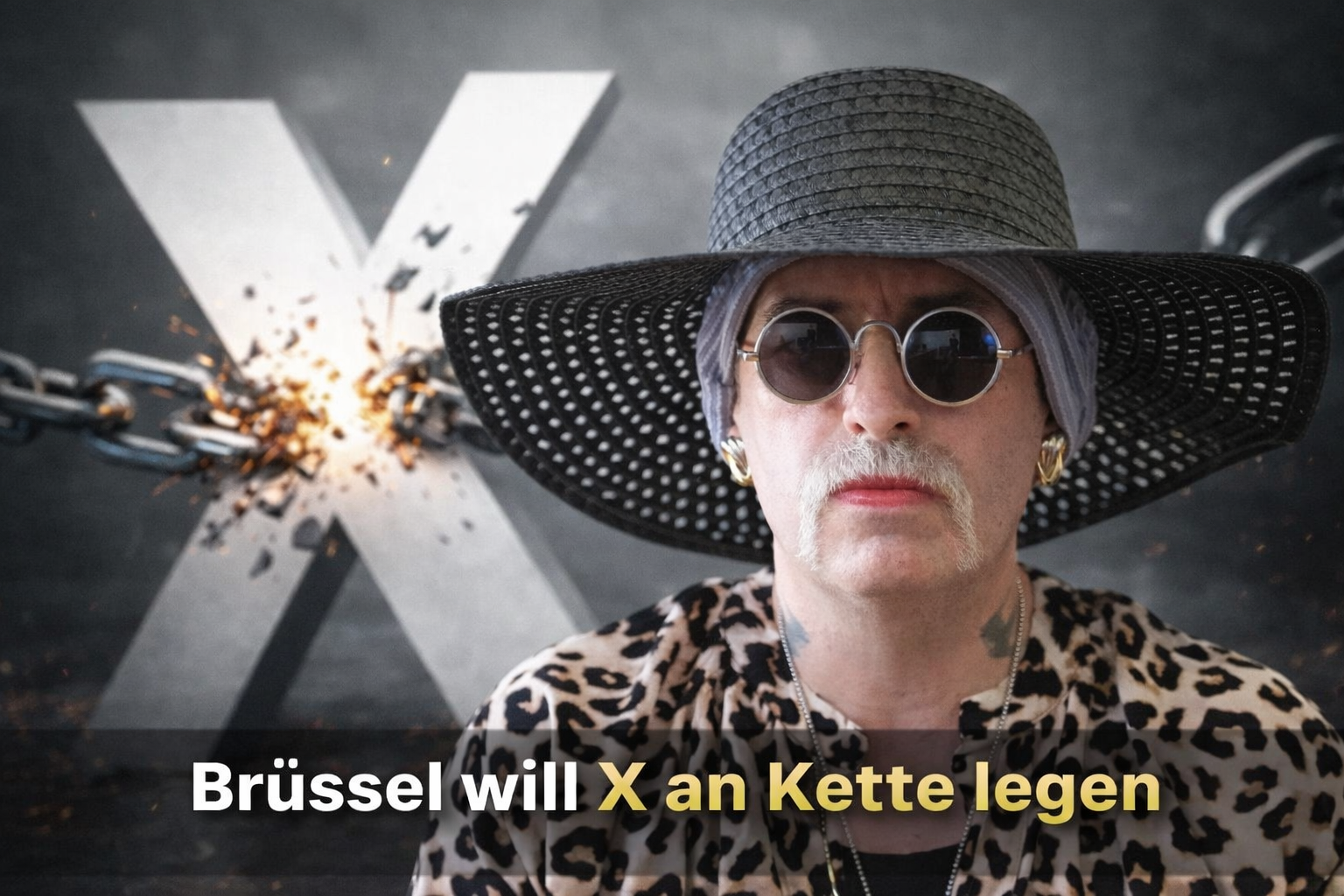
What is currently being mobilized against the platform X and the AI system Grok is officially framed as a data protection and security issue. But anyone who looks at the developments as a whole quickly realizes: this is not an isolated case. It is a political power struggle.
The starting point is a formal investigation by the UK data protection authority Information Commissioner’s Office. Under investigation are X, the company xAI, and the AI system Grok. The allegation is that personal data may have been processed unlawfully, particularly in connection with the generation of problematic images.
Zu diesem Thema wurde zusätzlich ein separates Videostatement veröffentlicht, in dem die laufenden Verfahren gegen X und ihre politische Einordnung zusammengefasst und erläutert werden.
Taken on its own, this would be a routine procedure. But this case does not stand alone.
At the same time, investigations are underway at the European level. There were raids in France. Summonses were issued. The European Commission is reviewing X for possible violations of the Digital Services Act. Europol is also involved.
Multiple states, multiple authorities, multiple proceedings — against the same platform, in a short period of time, with a similar direction.
This is no coincidence.
Regulation as a Tool of Power
For years, Europe has been engaged in a conflict with open digital spaces. Not because these spaces are inherently dangerous, but because they evade state control. Platforms where opinions become visible before they are categorized, filtered, or moderated do not fit into a system built on control.
This is not about whether data protection matters. Data protection does matter.
Nor is it about whether artificial intelligence needs to be regulated. Of course it does.
The decisive question is this: Is regulation being used for protection — or for discipline?
The pattern is familiar. First moral outrage. Then legal review. Then regulatory pressure. In the end, there is no open censorship, but adjustment. Self-restraint. Preemptive conformity.
Open speech does not disappear through bans. It disappears through uncertainty.
Why X Disrupts
From a European perspective, X is not a technical problem but a political one. The platform is uncomfortable because debates take place there that cannot be fully controlled. Because reach does not depend exclusively on state-approved narratives. Because public visibility emerges without prior approval.
That makes X dangerous for systems that rely on narrative control.
That is why it is not openly banned.
It is reviewed.
Investigated.
Regulated.
With clean language.
With formal procedures.
With the claim of protecting the good.
But the effect remains the same: restriction of open discourse.
Conclusion
What we are witnessing right now is not a data protection war. It is a power struggle over the digital public sphere. And this struggle is not being fought with open bans, but with legal instruments.
Brussels does not want to shut down X.
Brussels wants to control X.
And that is where the real problem lies.
📚 Further Reading – Partner Links
(Affiliate notice: The following links are partner links. If you make a purchase through them, you support Marlas Army at no additional cost to you.)
1. Hannah Arendt – On Violence
1. Hannah Arendt – On Violence
An analysis of the mechanisms of political control and public fear.
👉 https://amzn.to/3NDc0c8
2. George Orwell – 1984
The classic work on language control, truth, and surveillance.
👉 https://amzn.to/4bsO0SZ
3. Timothy Snyder – On Tyranny
Twenty lessons on how democracies die.
👉 https://amzn.to/3NcdiuI
Leave a Reply