
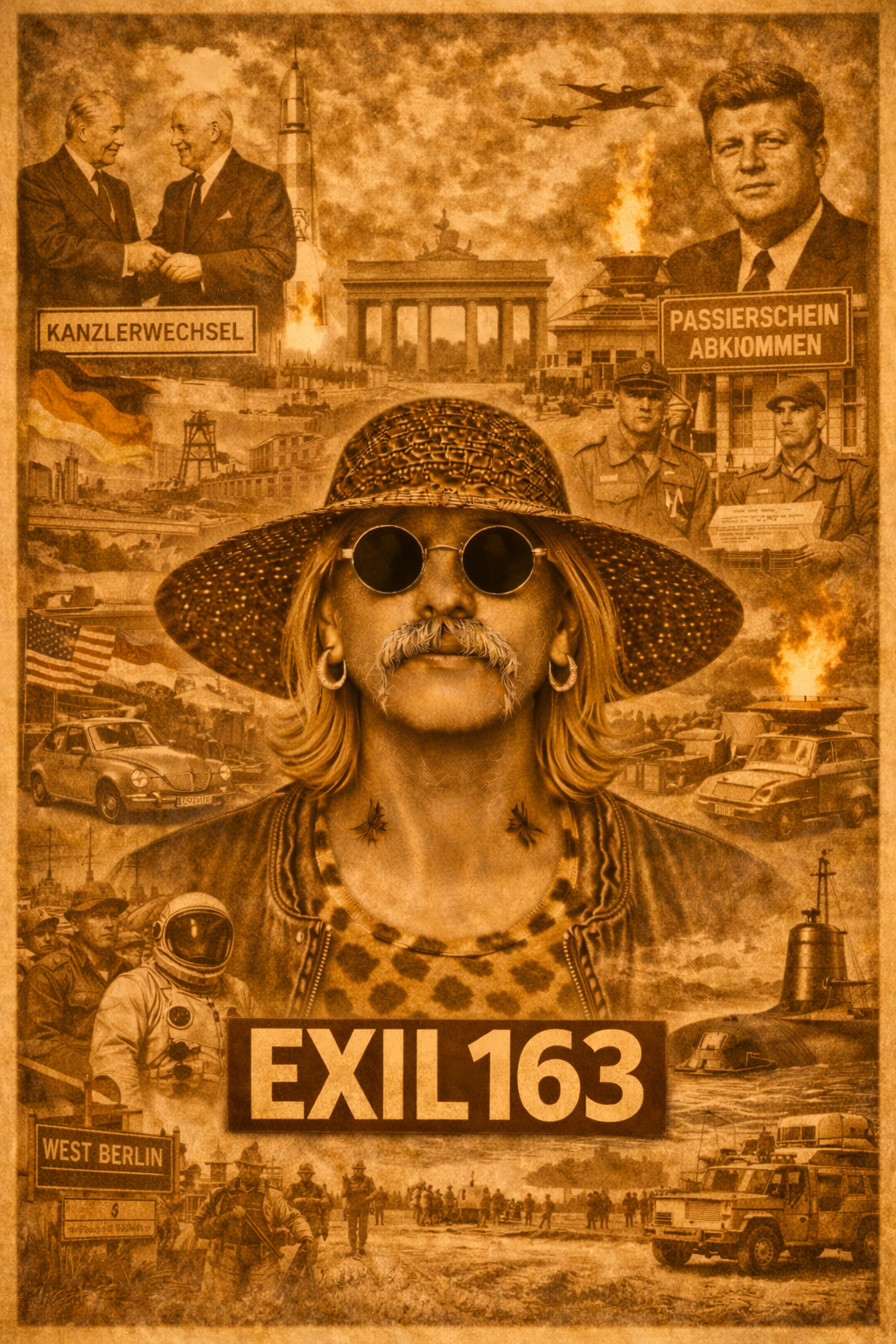
Heute ist der Tag 163 meines Exils.
Exile 163.
Nineteen sixty-three is marked by a cautious realignment after years of escalation. The world lives with the memory of the Cuban Missile Crisis, and many governments are looking for ways to limit future escalations.
In the Federal Republic, political transitions shape the year. After a long tenure, Konrad Adenauer steps down, Ludwig Erhard assumes the chancellorship and represents economic stability amid a changing international environment. The Franco-German Friendship Treaty marks an attempt to overcome old antagonisms through institutional cooperation.
In the GDR, the political order under Walter Ulbricht remains firmly entrenched. At the same time, a cautious movement becomes visible in Berlin. With the pass agreement, West Berliners are allowed for the first time since the Wall was built to visit relatives in the East. It is not a breakthrough, but a limited form of human contact in a divided country.
Germany remains embedded in the logic of two power blocs. Security policy is decided not only in Bonn or East Berlin, but in Washington and Moscow. The interests of the superpowers shape the scope of action of both German states.
Internationally, the year sends contradictory signals. The agreement to halt above-ground nuclear tests points to learning processes after the near catastrophe of the previous year. At the same time, the assassination of John F. Kennedy shakes the global balance of power and creates new uncertainty.
Nineteen sixty-three shows that history rarely follows a straight line. Rapprochement and isolation exist side by side, shaped by the decisions of many actors and their respective interests.
Exile 163.
Between concrete and treaties, hope remains quiet but tangible.
Exile Chronicle
All previous (from 130 – earlier entries are on X/Twitter) and ongoing entries of my Exile Chronicle are collected and documented here:
👉 https://marlas.army/exil-chronik/
Leave a Reply