
Why I Was Convicted — and Why Those Convictions Should Have Been Overturned
This exile is not a personal retreat. It is the result of a political and legal process that exemplarily shows how freedom of expression, judicial interpretation, and the political climate intersect — and in doing so can drift away from the rule of law.
I name names. Because accountability is not an anonymous principle.
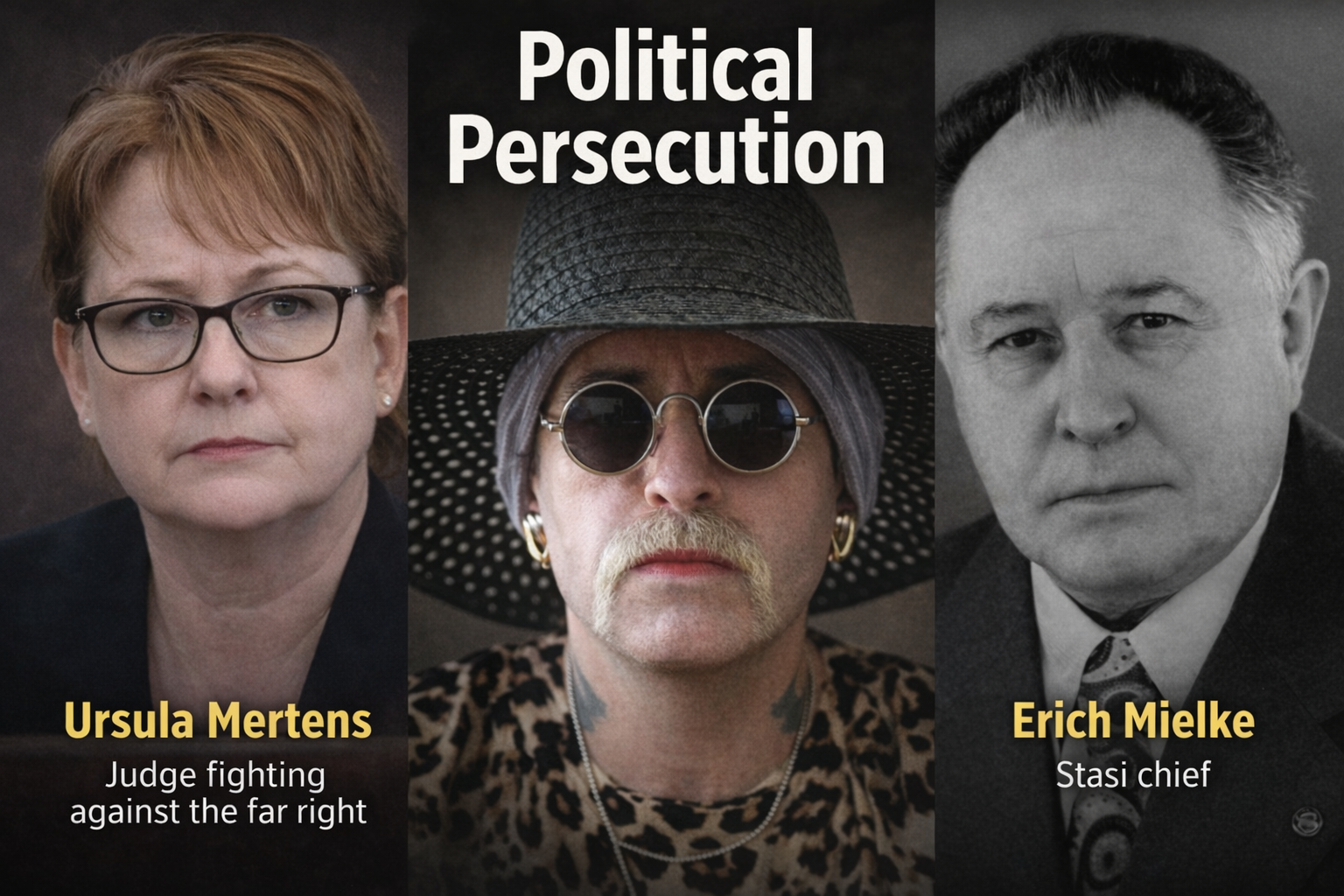
The key figure: Ursula Mertens
At the center is Ursula Mertens, presiding judge of the 1st Criminal Senate at the Naumburg Higher Regional Court.
Her decision of May 15, 2025 (1 ORs 21/25) dismissed the appeal against my conviction. Not because of a lack of arguments, but — in my view — because of a maximally politicized interpretation.
Attorney Dirk Schmitz has sharply and pointedly characterized this judge in his article. This characterization matters — not as a smear, but as criticism of a judicial style that has drifted away from constitutional guardrails.
A Freisler-like tone instead of constitutional balancing
What characterizes the reasoning of the judgment is less its legal substance than its moral dramatization. Instead of a sober analysis, there was assumption, generalization, and exaggeration — consistently to the detriment of the defendants.
This is reminiscent of a Freisler-esque approach:
- Condemnation instead of differentiation
- Ideological scrutiny instead of assessment of the act
- Maximalist interpretation instead of respect for fundamental rights
No one claims an identity with Nazi-era justice. But style, tone, and method are the issue. The rule of law does not live by outcomes alone, but by the path taken to reach them.
The central legal violation: ambiguous interpretation to the detriment of the defendants
According to the established case law of the Federal Constitutional Court, the following applies:
Ambiguous statements may not be interpreted to the detriment of the accused in criminal law.
That is exactly what happened here.
A polemical, provocative, tasteless — yes — expression of opinion was interpreted as if I had made a factual claim about all refugees. This generalization does not exist in the wording, but was constructed in order to satisfy § 130 of the German Criminal Code.
This is not interpretation; it is reinterpretation.
The conflation of opinion and fact
The contested passages were part of a political dispute, directed at counter-demonstrators (“Omas gegen Rechts”). The core was value judgment, not a statement of fact.
The Federal Constitutional Court explicitly protects even exaggerated, polemical, and offensive opinions, as long as they are not asserted as verifiable statements of fact. This dividing line was ignored.
Human Dignity as a Blunt Instrument
Particularly problematic is the reasoning that my statements allegedly denied human dignity to all refugees.
Human dignity is the highest constitutional threshold. It is not violated merely because language is harsh, cynical, or offensive.
A violation of human dignity requires that people be portrayed as inferior, without rights, or no longer belonging to the community.
This threshold was asserted, but not substantiated.
Incitement Without a Threat to Public Peace?
Section 130 of the German Criminal Code requires more than moral outrage. It requires a qualified capacity to disturb the public peace.
A single provocative speech in the context of a demonstration — without proven escalation — does not meet this threshold.
The reasoning remains abstract, not concrete. That is not sufficient under criminal law.
The constitutional complaint: well-founded — and nevertheless dismissed
My constitutional complaint was legally sound.
It addressed precisely these points:
- incorrect interpretation
- disregard for ambiguity
- impermissible expansion of § 130 of the German Criminal Code
- curtailment of Article 5 of the Basic Law
That it was nevertheless dismissed is not evidence of its weakness — but a signal of the political climate. When the issue became publicly charged, the will to correct was lacking. Even the highest judges are not immune to time pressure and prevailing expectations.
The Deep State — a Structure, Not a Slogan
What becomes visible here is not a secret cabal. It is a functional entanglement:
- political expectation pressure
- media prejudgment
- judicial alignment
- institutional self-confirmation
This is the deep state of the Federal Republic: not hidden, but effective through routines, careers, and conformity.
Why Exile?
Because a fair trial under these conditions became illusory.
Because judgments that should have been overturned were affirmed.
And because freedom is more than the mere existence of courts — it requires independence, courage, and distance.
Conclusion
My case is not an isolated one. It is a precedent of deterrence.
Those who say the wrong things are not refuted — they are criminalized.
I am in exile.
But I have not been silenced.

Transparency Notice
This post contains affiliate links. If you make a purchase through these links, I may earn a small commission. There is no additional cost to you.
Further Reading on Freedom of Expression, the Judiciary, and Political Persecution
📘 The Terrible Jurists — Ingo Müller
A classic work on the continuities of the German judiciary from the Nazi era into the Federal Republic. Essential reading for understanding why the judiciary is never automatically neutral.
👉 Amazon: https://amzn.to/4qeZjmz
📕 1984 – George Orwell
Not a novel, but a guide to recognizing political distortion of language, ideological justice, and abuse of power.
👉 Amazon: https://amzn.to/45Be2zH
📗 Rule of Law at an End — Ralph Knispel
Analysis of the erosion of rule-of-law principles under political pressure — highly relevant in the context of my case.
👉 Amazon: https://amzn.to/3YA0SiC
📙 Freedom of Expression — Ronen Steinke
Why freedom of expression does not end where it becomes uncomfortable — and how courts are increasingly restricting it.
👉 Amazon: https://amzn.to/4aWG1gZ
Why These Books Are Listed Here
They provide the theoretical and historical foundation for what my case demonstrates in practice:
👉 How jurisprudence becomes political.
👉 How interpretation turns into a weapon.
👉 Why exile is possible within a formal rule-of-law state.
Leave a Reply