
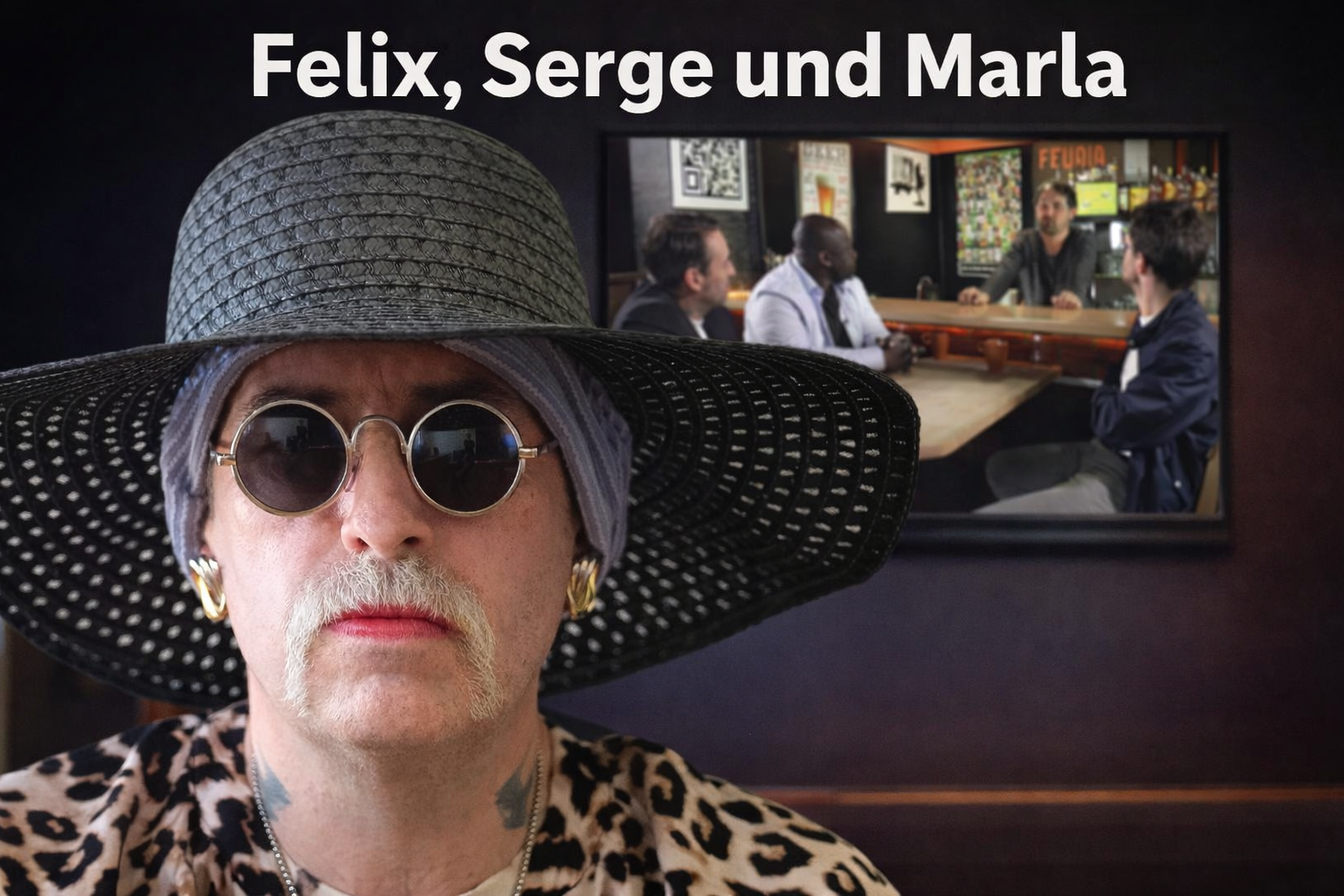
There are conversations you only truly understand years later.
This is one of them.
In 2018 — seven years ago — I sat in a discussion round with Serge Menga.
One full hour. Direct. Unfiltered. No PR, no editing, no “you can’t say that anymore.”
And above all:
I wasn’t just “Marla, the woman in the group.”
I was there under a false name.
Why undercover?
Very simple:
Because men talk differently when they’re only among men.
Anyone who doesn’t believe that has never seen how a room changes the moment “the woman” is sitting at the table as a role.
Not because women are “to blame” — but because many men automatically start performing:
some get sleazier,
others more cautious,
and the next ones suddenly play the protector.
I didn’t want that.
I didn’t want to be the person everyone reduces you to.
I wanted to be the person who argues.
So I presented myself as masculine.
Deliberately.
No drama. No theater.
And yes — for me it wasn’t even particularly difficult.
Genetically, many of us women in my family have strong facial hair growth.
In many parts of the world, that’s completely normal.
Only in Europe people laugh about it.
In other parts of the world, people are more likely to laugh about women without a beard.
Sometimes it’s that simple.
Why I’m publishing this video today
Because it offers an insight you can hardly find anymore today:
How I thought back then.
How I spoke.
How I debated.
How I argued.
And anyone who really listens will quickly notice:
It doesn’t match the image some people today desperately want to paint of me.
Because this accusation — that I am “far-right” — isn’t just false.It’s a cheap narrative.
A box people put you in so they don’t have to listen.
If you put people into boxes, you don’t have to deal with what they actually say.
It’s the easiest way to kill discussions.
What you’ll see in this conversation
You won’t see a staged performance.
You won’t see a polished version.
You’ll see a real discussion.
And you’ll also see how much this country has changed over the years:
What you could still debate back then without immediately being given a label.
How many topics today are no longer discussed openly, because everyone is afraid of “seeming wrong”.
That’s exactly why it’s worth watching this video today.
Not because everything in it is perfect.
But because it’s real.
Conclusion
This video is a document of its time.
And if you want to know who I really am —
then don’t look at other people’s headlines.
Look at what I say.
And listen to how I think.
The full video is now online on YouTube.
Let’s watch it together.
📚 Further Reading – Partner Links
(Affiliate notice: The following links are partner links. If you make a purchase through them, you support Marlas Army at no additional cost to you.)
1. Hannah Arendt – On Violence
1. Hannah Arendt – On Violence
An analysis of the mechanisms of political control and public fear.
👉 https://amzn.to/3NDc0c8
2. George Orwell – 1984
The classic work on language control, truth, and surveillance.
👉 https://amzn.to/4bsO0SZ
3. Timothy Snyder – On Tyranny
Twenty lessons on how democracies die.
👉 https://amzn.to/3NcdiuI
Leave a Reply