
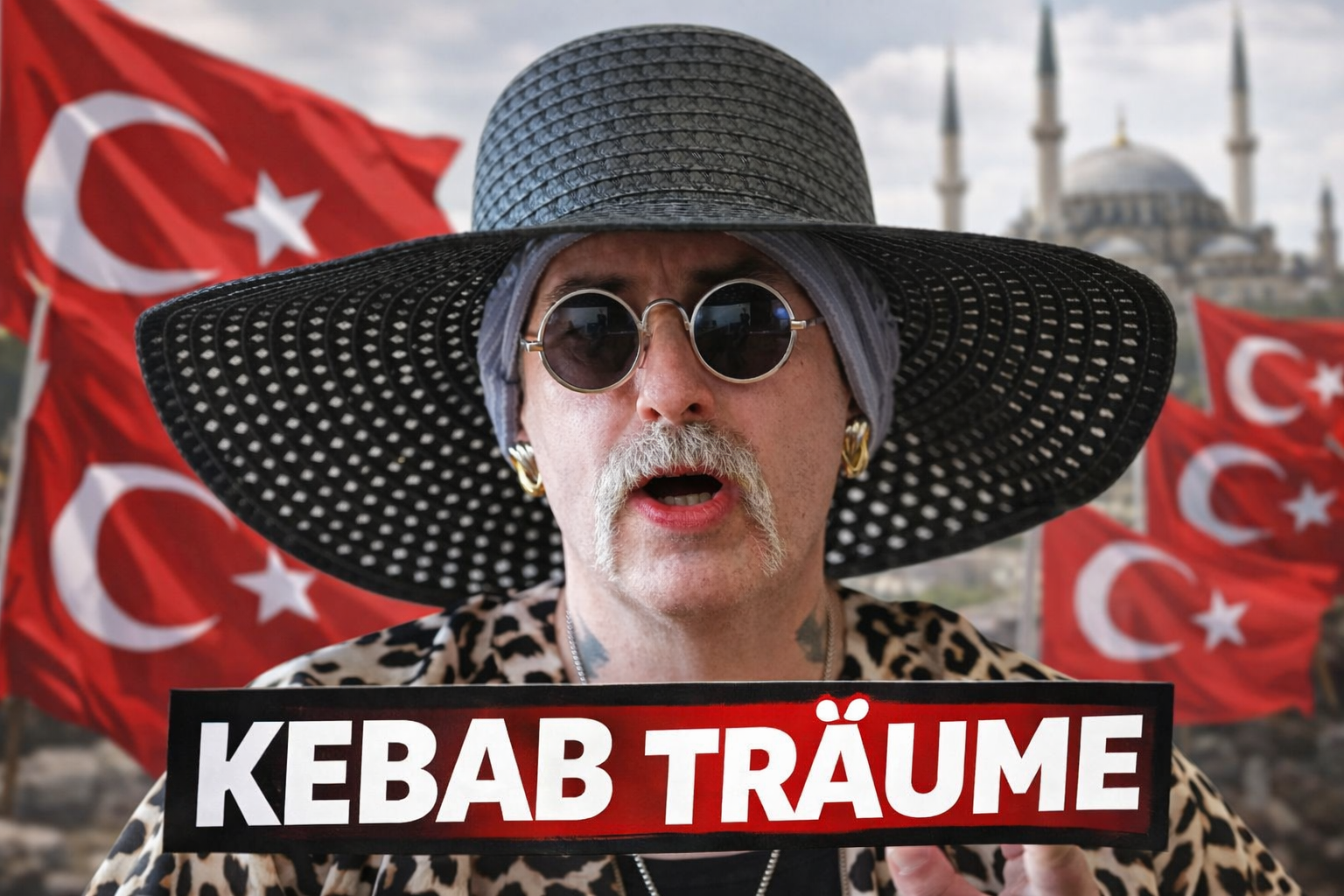
Turkey is often viewed in Germany as a foreign experiment.
A special case.
A country that “works differently.”
That is convenient.
And wrong.
Turkey is not an exotic outlier. It is a case study of what happens when a state, over the course of years, abandons its own standards — not under coercion, but out of complacency.
A ergänzendes Videostatement vertieft die im Text dargestellten strukturellen Parallelen zwischen der Entwicklung der Türkei und aktuellen politischen Tendenzen in Deutschland.
The old Turkey: not perfect, but livable
Turkey was never a Western ideal.
But it was functional.
Religion was present, yes.
But it was embedded.
Restricted.
Pushed back from the state, the law, and education.
You could disagree.
You could laugh.
You could hold a different opinion without being afraid.
The decisive factor was not that there was no religion —
but that the state was stronger than religious claims.
More religion — less state
Today, Turkey looks different.
More mosques than ever before.
More religious symbolism in public spaces.
More moralizing language in everyday life.
At the same time:
more aggression,
more violence,
more arbitrariness.
This is no coincidence and no contradiction.
Islam is not a private hobby you take off in the evening like a coat.
It comes with clear ideas about how society should function — from family to law to authority.
As long as a state limits these ideas, it remains capable of acting.
Once it retreats, a vacuum emerges.
And that vacuum gets filled.
That is exactly what happened in Turkey.
The creeping retreat of the rule of law
The state did not suddenly capitulate.
It withdrew slowly.
Religious symbolism was first tolerated, then promoted, then protected.
Criticism was no longer considered normal, but disrespectful.
Boundaries were no longer enforced so as not to “offend” anyone.
Today, the law no longer applies equally to everyone.
It applies based on proximity to power.
On conformity.
On loyalty.
Those who go along live more quietly.
Those who object live more dangerously.
Justice has become predictable — but not fair.
Education as a disruptive factor
Another key to understanding Turkey’s development is education.
Educated people ask questions.
Uneducated people follow.
That is why education was not strengthened, but hollowed out.
Not quietly.
Not by accident.
But openly.
Those who think are disruptive.
Those who ask questions object.
And objection is dangerous for any system that relies on moral pressure instead of law.
Migration as a societal amplifier
There is also a factor that cannot be ignored: migration.
Millions of people from strongly religious regions were not integrated, but simply added.
Not with the expectation of adaptation —
but with the tacit acceptance that they would further shift the environment.
The more religious a society becomes, the weaker the resistance.
The more morality, the less law.
Mass replaces arguments.
The warning came earlier than we think
What is interesting is that this development was already sensed decades ago.
In the early 1980s, the band DAF sang the line in the Fehlfarben-covered song “Kebab-Träume”:
“We are the Turks of tomorrow.”
This was not a song about origin.
It was a song about development.
About self-abandonment.
About downward adaptation.
About the loss of one’s own standards.
What sounded provocative back then now feels frighteningly precise.
The German mirror
Germany is not where Turkey is today.
But Germany is where Turkey once was.
More religious special rules.
More consideration — but only in one direction.
Criticism is seen as aggressive, boundaries as inhumane.
The state retreats so as not to upset anyone.
Law is relativized.
Violence is downplayed.
Education is ideologically charged.
The patterns are identical.
Conclusion: States decay through complacency
Turkey does not show what must inevitably happen.
It shows what happens when people hope for too long instead of acting.
States do not fall apart because of toughness.
They fall apart through self-abandonment.
Anyone unwilling to learn from Turkey will one day have to explain why they saw everything — and still did nothing.
CTA:
Share.
Pass it on.
And above all: pay attention, while it is still possible.
In Marla We Trust.
📚 Further Reading – Partner Links
(Affiliate notice: The following links are partner links. If you make a purchase through them, you support Marlas Army at no additional cost to you.)
1. Hannah Arendt – On Violence
1. Hannah Arendt – On Violence
An analysis of the mechanisms of political control and public fear.
👉 https://amzn.to/3NDc0c8
2. George Orwell – 1984
The classic work on language control, truth, and surveillance.
👉 https://amzn.to/4bsO0SZ
3. Timothy Snyder – On Tyranny
Twenty lessons on how democracies die.
👉 https://amzn.to/3NcdiuI
Leave a Reply