
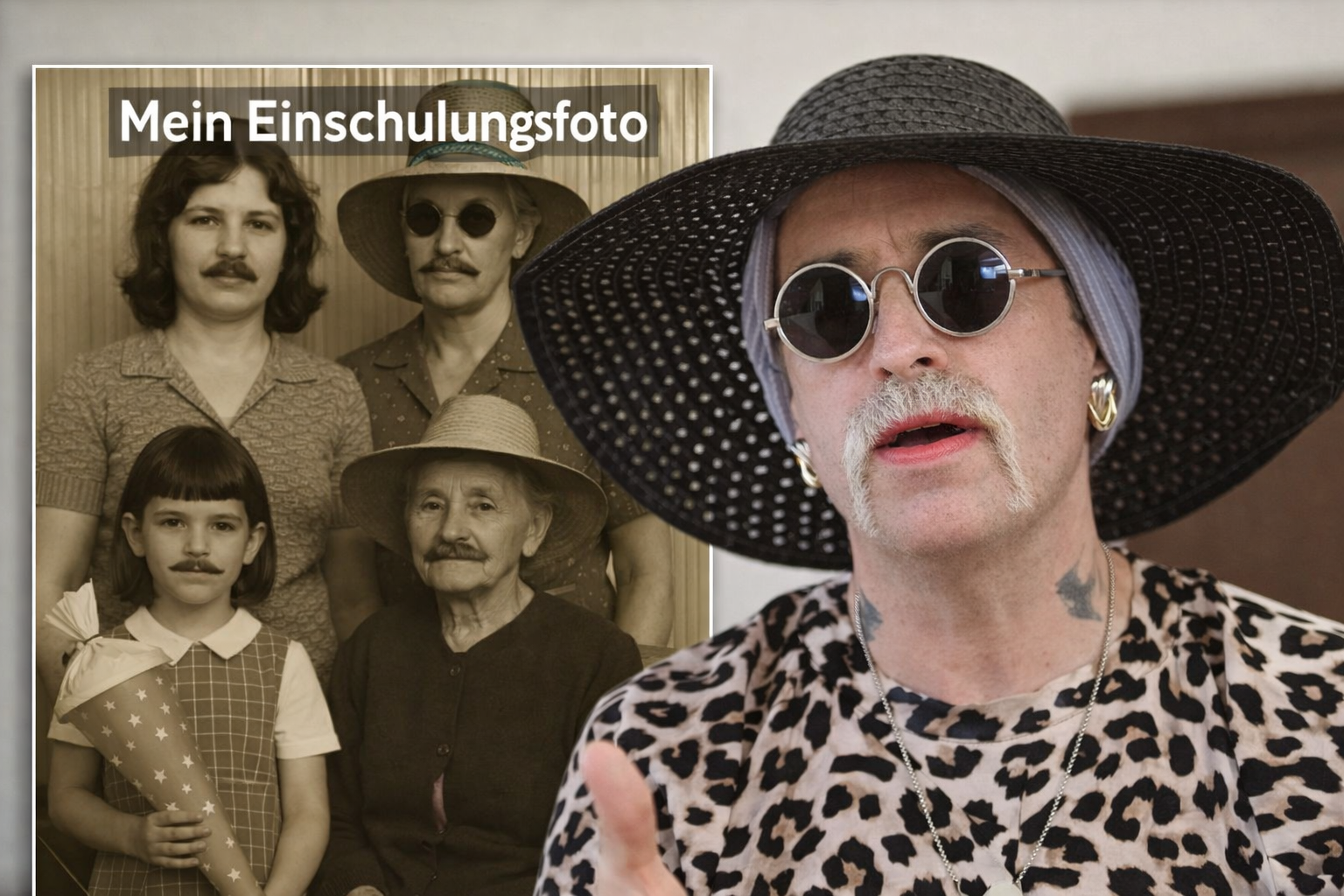
I don’t usually share intimate family photos. Not because I’m ashamed — but because family is something you protect. But at some point, the game some people are playing with me has to stop.
A ergänzendes Videostatement mit dokumentierender Einordnung wurde separat veröffentlicht und ist hier abrufbar.
For months now, people have been fixating on a single detail: my beard. And suddenly that’s supposed to be enough to call everything into question. My identity. My gender. My entire life. As if a beard were an official stamp. As if a bit of body hair could decide whether someone is “really” a woman or not.
So now I’m doing something I never actually wanted to do: I’m putting it on the table. Plain and simple. Black on white. Image by image.
This photo is from 1977 — from an old family album. School enrollment. Four generations of women in my family. No story, no filter, no internet, nothing “artificially generated.” A real photo from a real life.
You can see my mother, my grandmother, and even my great-grandmother — the woman with the hat. And me as a child in front of them.
And yes: it was already visible back then. It was already an issue back then. Not because I “wanted to be different,” but because it simply was that way. Because some women have body hair. Because some women develop facial hair. And because people prefer to elevate themselves above others rather than simply accept that nature doesn’t fit into their boxes.
In my family, this wasn’t just considered “unusual,” but a stigma passed down across generations. In her time, my great-grandmother was even forced to appear in so-called curiosity and ethnological shows — as a “woman with a beard.” For a few pennies. For the amusement of others. And anyone who believes that was a harmless circus gag hasn’t understood what it means when a person is turned into an attraction simply because their body doesn’t fit the image the crowd expects. That wasn’t funny. It wasn’t voluntary. It was humiliation.
And that very humiliation hangs over a family like a shadow. My mother later even pressured me, before my Jugendweihe, to shave off the beard. Not because she hated me — but because she was afraid. Because she knew how people are. Because she knew how merciless it gets the moment someone doesn’t appear “normal.” There may even still be photos of that — I’ll have to look for them someday. But this memory alone already shows it: this is not about “vanity.” It’s not about “style.” It’s about pressure. About conformity. About shame imposed from the outside.
I hid for a long time. I shaved so it wouldn’t be noticeable. I made myself small so others wouldn’t get upset. I even presented myself as a man at times, simply to escape that constant fixation — that look that doesn’t ask how you’re doing, but only: “What are you, anyway?”
And that’s exactly the core of it: this issue is not superficial. It is psychologically burdensome. It is constant stigmatization. It is a permanent “you are wrong.” And it’s frightening how many people in 2026 still believe they can determine a person’s gender by a beard.
A beard is not proof of anything — except that a body grows hair. Period.
And while people in Central Europe often act as if this were some absolute exception, a look at the world shows the opposite: women with stronger body hair exist everywhere. Depending on background, genetics, hormonal balance, age, or simple predisposition. And in some regions of the world, this isn’t even a topic. There, women with beards aren’t mocked — it’s more likely considered normal, a sign of maturity or strength, and sometimes the situation is even reversed: it’s more unusual when a woman has no visible body hair at all.
The problem isn’t on the face. The problem is in the mind.
I’m not making this post to get pity. I’m also not making it to “justify” myself. I’m making it as clarification. As a boundary. As evidence. Because the hostility I now experience — even from authorities, institutions, and supposedly “serious circles” — has become so blatant that I will no longer stay silent.
So if anyone in the future thinks they can use my beard as an “argument” against my identity, this is what I say: the photo is from 1977. And it is real.
I am a woman. I was one as a child. I am one today. And I will no longer apologize for existing.
#WomanWithABeard #Family #FreeMarla
📚 Further Reading – Partner Links
(Affiliate notice: The following links are partner links. If you make a purchase through them, you support Marlas Army at no additional cost to you.)
1. Hannah Arendt – On Violence
1. Hannah Arendt – On Violence
An analysis of the mechanisms of political control and public fear.
👉 https://amzn.to/3NDc0c8
2. George Orwell – 1984
The classic work on language control, truth, and surveillance.
👉 https://amzn.to/4bsO0SZ
3. Timothy Snyder – On Tyranny
Twenty lessons on how democracies die.
👉 https://amzn.to/3NcdiuI
Leave a Reply