
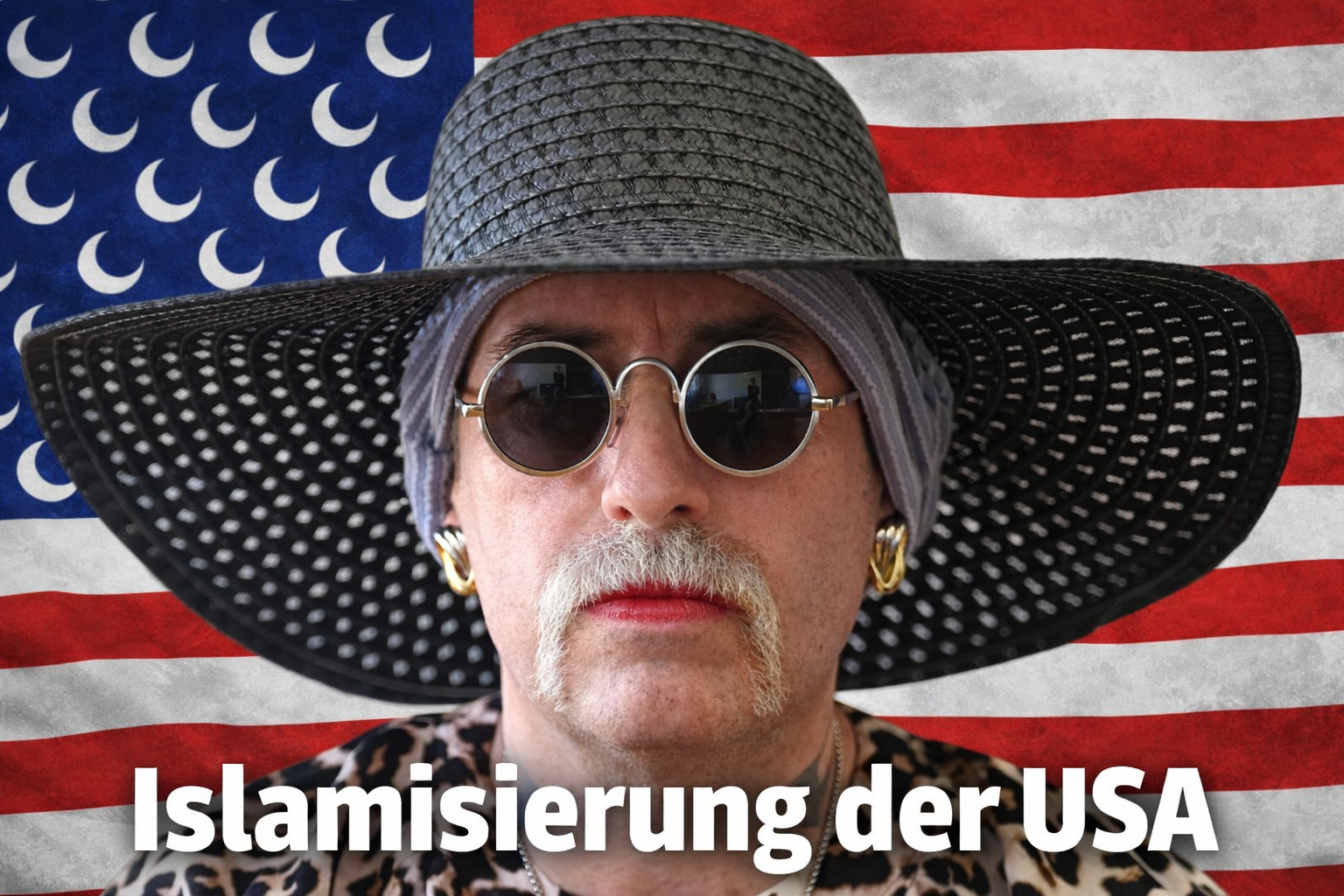
What many considered an exclusively European problem is increasingly appearing in the United States as well: the demographic, political, and social shift driven by growing Muslim communities—flanked by a pro-Islamic left and a political class that reflexively labels criticism as “Islamophobia.”
For now, the Muslim share of the population in the U.S. is still significantly lower than in Western Europe. But the dynamic resembles the early 2000s in Europe. Anyone who looks more closely can recognize familiar patterns.
Demographics: A Small Minority, Rapid Growth
An estimated four to 4.5 million Muslims live in the United States. That corresponds to roughly 1.2 to 1.4 percent of the population. Since the turn of the millennium, this number has more than doubled. A large share were born abroad.
Projections suggest that the number will continue to rise significantly in the coming years. In purely percentage terms, the United States is roughly where some Western European countries were 20 to 25 years ago.
The development does not begin spectacularly. It begins gradually.
Islamist Terrorism: A Recurring Pattern
Isolated Incidents? Or Warning Signs?
Time and again, acts of violence motivated by Islamist ideology shake the country. Perpetrators openly cite religious motives, declare allegiance to radical ideologies, or maintain connections to extremist networks.
The problem is not faith itself.
The problem is the ideology of political Islam.
Jihadist radicalization does not arise in a vacuum. It develops in environments that promote religious superiority, reject Western values, and emphasize loyalty to foreign centers of power.
Anyone who ignores this is denying reality.
Parallel Societies: Dearborn as a Symbol
In Michigan lies the city of Dearborn. More than half of its residents are of the Muslim faith, many with roots in the Middle East.
There are large mosque complexes, Islamic cultural centers, and a local political structure strongly shaped by this community. Critics see this as an example of a parallel society becoming increasingly entrenched.
The pattern is familiar:
First a local majority.
Then cultural dominance.
Then political power.
What appears formally democratic in fact changes the cultural structure of a region.
Texas: The Campus as a Power Base
Even in conservative Texas, projects are emerging that go far beyond an ordinary mosque. Plans include comprehensive Islamic campus structures near universities—with religious authority, their own dormitories, ideological training, and financial independence.
Such projects follow a clear logic:
Not integration into existing structures, but the construction of their own.
When education, financing, housing, and religious leadership are organized within a closed system, a cultural ecosystem with little external connection emerges.
That is not religious freedom in the classical sense.
That is institutionalized separation.
Political Alliances: The Role of the Left
A decisive factor is the political backing from progressive circles. Under the banner of anti-discrimination, diversity, and minority protection, even problematic developments are rarely questioned critically.
Anyone who points out problems is quickly labeled “right-wing” or “Islamophobic.”
This moral shielding creates spaces in which radical structures can grow.
This dynamic became particularly visible during pro-Palestinian mobilizations. What begins as a solidarity movement sometimes shifts into open hostility toward Western institutions and Israel—accompanied by religious rhetoric.
Welfare Fraud and Clan Structures
Cases of large-scale welfare fraud are also increasing in the United States within certain community structures. In Minneapolis in particular, a network was uncovered that systematically abused government aid programs.
Such cases fuel the impression that state systems are being exploited while criticism is treated as taboo.
Of course, not all members of a community are involved.
But when structures can establish themselves over many years, the question arises whether politics has chosen to look the other way.
Ideological Loyalties
Particularly explosive are reports about children and adolescents in religious institutions making declarations of loyalty to foreign leadership figures.
When minors describe themselves as “soldiers” of religious or political authorities outside the United States, a fundamental question arises:
Where does primary loyalty lie?
Integration does not only mean economic participation.
It means identification with one’s own state.
Conclusion: Not Europe Yet – But on the Way?
The United States is not at the same point as some Western European countries. But the patterns are similar:
• rapid population growth
• local centers of power
• political backing
• the tabooing of criticism
• ideological parallel structures
The crucial difference:
The United States is earlier in the process.
This theoretically opens the possibility of responding decisively—through clear security measures, transparent oversight of foreign funding, consistent prosecution of extremist networks, and an integration policy that demands loyalty to the constitution.
The alternative would be to repeat the same mistakes that have long been visible in Europe.
Whether the United States will go down this path or change course in time will be decided in the coming years.
In Marla We Trust.

📚 Further Reading – Partner Links
(Affiliate notice: The following links are partner links. If you make a purchase through them, you support Marlas Army at no additional cost to you.)
1. Hannah Arendt – On Violence
1. Hannah Arendt – On Violence
An analysis of the mechanisms of political control and public fear.
👉 https://amzn.to/3NDc0c8
2. George Orwell – 1984
The classic work on language control, truth, and surveillance.
👉 https://amzn.to/4bsO0SZ
3. Timothy Snyder – On Tyranny
Twenty lessons on how democracies die.
👉 https://amzn.to/3NcdiuI
Leave a Reply