
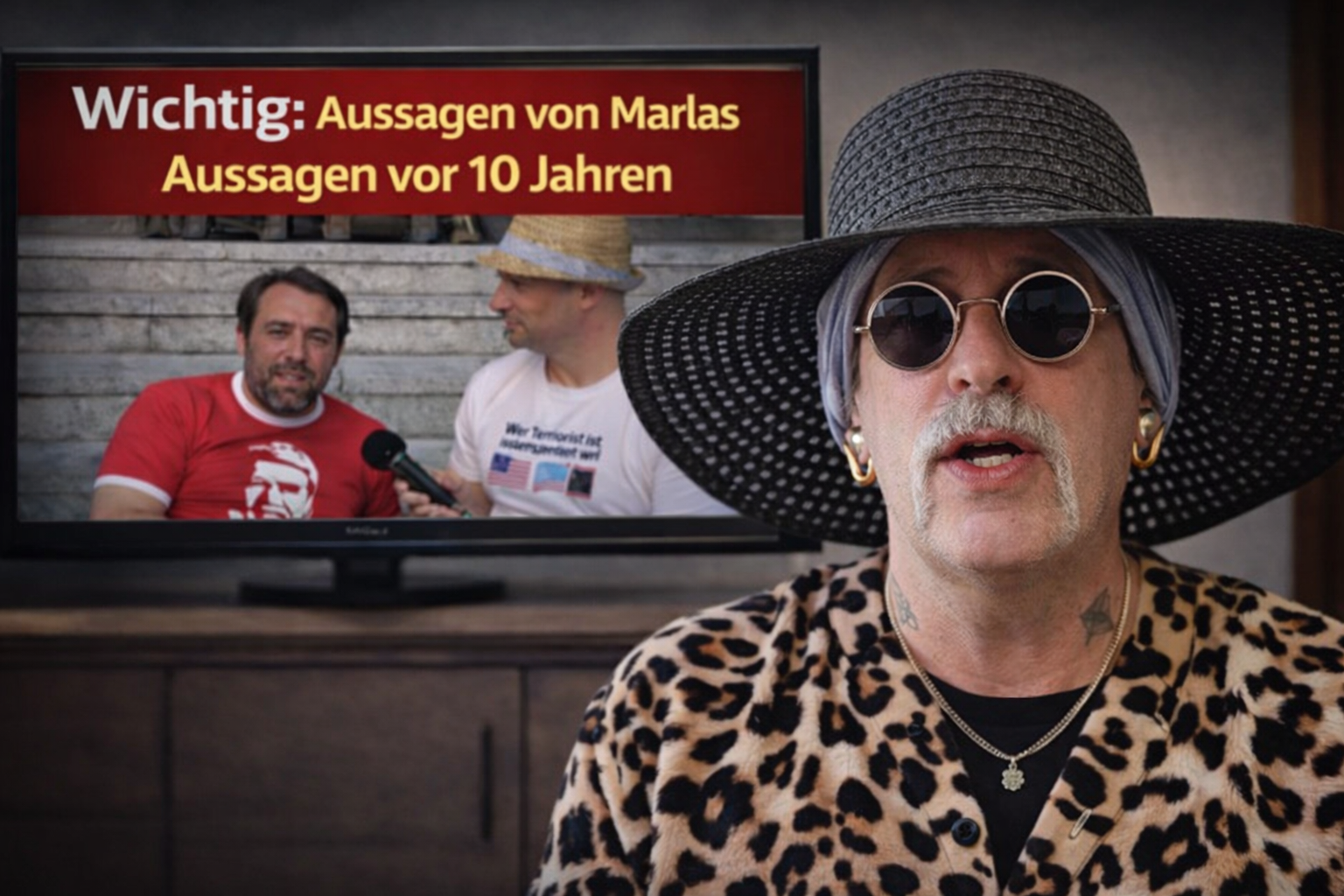
This video is from 2015.
I’m publishing it again today because its message isn’t outdated —
it was pushed aside.
2014: Peace Without Factions
In 2014, after the start of the Ukraine conflict, the events around the Maidan, the so-called “Orange Revolution,” the massacres in Donbas, and the fire at the Trade Union House in Odessa, the Monday peace demonstrations emerged in Berlin.
At the beginning, these demonstrations were open.
People from all political camps came together — not united by ideology, but by a shared goal: peace..
There were no party flags, no fixed camps, no prescribed attitudes.
That is exactly what made this movement so unusual — and so vulnerable.
Within a short time, these peace demonstrations spread to more than 140 cities. aus.
Halle: Participation and the First Hostilities
We also took part in Halle — at my initiative.
Even before we became actively involved, public stigmatization began.
Early on, the demonstrations were labeled as
“infiltrated by the far right,”
“aluhat events,”
or denounced as a “cross-front.”
These accusations did not come from within the movement itself, but from outside:
from parts of the Antifa — and from an institutionalized peace scenethat claimed to stand for peace, but in reality did not participate..
I deliberately call these structures a club/association or NGO mafia::
organizations that operate with government funds, claim interpretive authority — and at the same time fight genuine, uncontrollable grassroots peace movements.
Continuity Instead of Activism
Despite — or precisely because of — these hostilities, I kept the topic going.
The peace demonstration in Halle continued for years..
Um organisatorischen Aufwand zu reduzieren, meldete ich sie langfristig an – bis 2067.
Not as a symbolic gesture, but as an expression of perseverance..
Peace is not an event.
Peace is an attitude.
2015: The Conversation on the Town Hall Steps
In 2015, I spoke on the steps at the marketplace in Halle with Frank Geppert.
The conversation is documented in the embedded video below.
We talk about:
- Peace beyond slogans
- Association and power structures that co-opt or destroy movements
- Political guerrilla actions as a form of protest
- Performance art as a tool to make content visible
Back then, I deliberately spoke in a male role. gesprochen.
Not as provocation, not as a masquerade — but as an artistic device,to be heard.
That was performance art.
But it was not fiction.
Why This Video Matters Today
Many of the mechanisms we talked about back then are now clearly visible:
- Protest is delegitimized
- Peace is rhetorically co-opted
- Independent movements are defamed
- Institutional actors secure control over the narrative
This video is not a piece of evidence.
It is a historical document..
I am making it available again — not out of nostalgia, but for context.
Listen to it.
Not to agree with me — but to check for yourself what has become reality today.
Book Recommendations on the Topic (Affiliate)
(Advertising – these links are affiliate links. If you buy through them, you support Marlas Army at no extra cost to you.)
📘 The True Believer: Thoughts on the Nature of Mass Movements
Dieses Buch ist ein Klassiker darüber, wie und warum Massenbewegungen entstehen — von politischen Bewegungen bis zu sozialen Erwartungshaltungen. Hoffer analysiert, wie Menschen sich kollektiven Zielen anschließen, aber auch wie Bewegungen sich selbst transformieren oder instrumentalisieren lassen.
Leave a Reply