
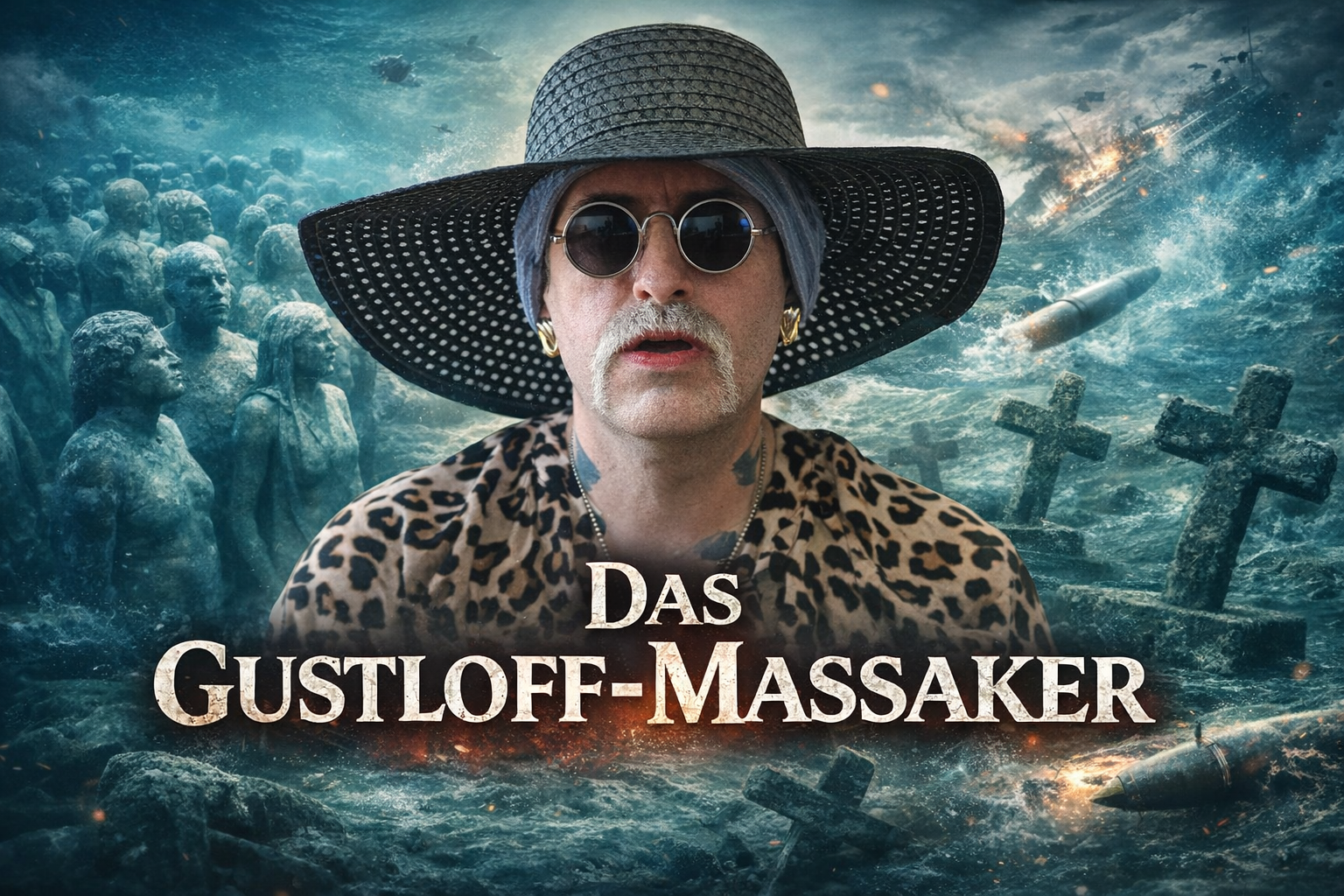
Everyone knows the Titanic.
Almost no one knows the Wilhelm Gustloff.
Yet on board, five to six times as many people died as in the world’s most famous maritime disaster.
Not because of an iceberg.
But because of torpedoes.
What happened in the Baltic Sea in the winter of 1945 was not an “accident.”
It was mass death.
And to this day, it has been pushed out of the collective memory.
A separately published video statement documents the historical events surrounding the sinking of the Wilhelm Gustloff and complements the written account.
When Remembrance Becomes Selective
When people are asked about the greatest maritime disaster in history, the answer is almost always the same: Titanic.
1,500 dead.
Hollywood.
Orchestra.
Iceberg.
But on January 30, 1945, a ship sank in the Baltic Sea on which between 7,500 and 9,300 people died—within less than an hour.
Women.
Children.
Refugees.
Wounded.
The Wilhelm Gustloff remains the deadliest ship sinking in history to this day.
And yet hardly anyone knows about it.
Why?
Because remembrance is not neutral.
Because images decide.
Because victors write—and the defeated are meant to remain silent.
Winter 1945: The Baltic Sea as the Last Escape Route
At the beginning of 1945, the Eastern Front collapses.
East Prussia, West Prussia, Pomerania—entire regions descend into panic.
Hundreds of thousands of civilians attempt to flee.
The land route is cut off.
The only hope: the Baltic Sea.
The German Navy launches an evacuation unlike any before.
Short notice.
Chaotic.
With ships completely overcrowded.
It is winter.
Minus twenty degrees.
Ice on the water.
Ice on the decks.
What was meant as rescue becomes a death trap.
Three Ships – Over 20,000 Dead
Three names stand for the scale of this catastrophe:
Wilhelm Gustloff – sunk on January 30, 1945
Steuben – sunk on February 10, 1945
Goya – sunk on April 16, 1945
On these three ships alone, more than 20,000 people died.
More than in the entire First World War at sea.
Wilhelm Gustloff
Over 10,000 people on board.
More than 8,000 of them refugees.
Among them thousands of children.
Several babies are born during the voyage.
Then three Soviet torpedoes strike the ship.
At night.
In bitter cold.
Anyone who does not die immediately ends up in the water.
At minus twenty degrees.
Most of them freeze to death within minutes.
Steuben
A hospital transport ship.
Severely wounded.
Amputees.
Unconscious.
When the torpedoes hit, emergency surgeries are still underway.
Many of the wounded are strapped to their beds—against the rough seas.
The ship sinks in less than 30 minutes.
Over 3,600 dead.
Goya
Not a passenger ship.
A simple ore freighter.
Over 7,000 people are crammed into the cargo hold.
People who believe they have made it.
After the sinking, only a few survive. 176.
Divers later reported that the cargo hold had looked
as if the ship had carried “nothing but bones and baby carriages.”
More Civilian Deaths Than All Other Warring Parties
In the final months of the war, the Baltic Sea saw more German civilian naval deaths than all the other warring nations in Europe combined.
The majority: women and children.
Why?
Because many men were forbidden to flee.
They were expected to keep fighting.
Or to die in the Volkssturm.
What remains are casualty lists with entries such as:
“Child.”
Without a name.
Without an age.
Invisible Graves, Forgotten Dead
While on land there are vast military cemeteries, these dead lie on the seabed.
Invisible.
Silent.
Forgotten.
The wrecks are considered naval war graves.
Protected resting places.
Yet they are looted.
By treasure hunters.
Souvenir seekers.
Hobby divers.
Bones are moved.
Objects are taken.
The peace of the dead is disturbed.
The German War Graves Commission attempts to document and protect these wrecks.
Case by case.
Fate by fate.
Because not every wreck is a grave.
And not every dead person is a naval war casualty.
But every person was a human being.
Warum wir darüber reden müssen
Dieser Text ist kein Versuch, Geschichte umzudeuten.
Er ist kein Relativieren von Schuld.
Und keine Täter-Opfer-Umkehr.
Er ist ein Einspruch gegen das Vergessen.
War does not end with capitulations.
It ends in mass graves.
Some lie on land.
Some beneath the water.
And both oblige us to look.
The Titanic is a myth.
The Gustloff is reality.
And that is precisely why it remains so uncomfortable to this day.
If this text matters to you:
Share it.
Repost it.
Talk about it.
Remembrance lives only if it is defended.
In Marla We Trust.
📚 Further Reading – Partner Links
(Affiliate notice: The following links are partner links. If you make a purchase through them, you support Marlas Army at no additional cost to you.)
1. Hannah Arendt – On Violence
1. Hannah Arendt – On Violence
An analysis of the mechanisms of political control and public fear.
👉 https://amzn.to/3NDc0c8
2. George Orwell – 1984
The classic work on language control, truth, and surveillance.
👉 https://amzn.to/4bsO0SZ
3. Timothy Snyder – On Tyranny
Twenty lessons on how democracies die.
👉 https://amzn.to/3NcdiuI

Leave a Reply to Bernd ThielCancel reply